I received some exciting art supplies for my birthday.
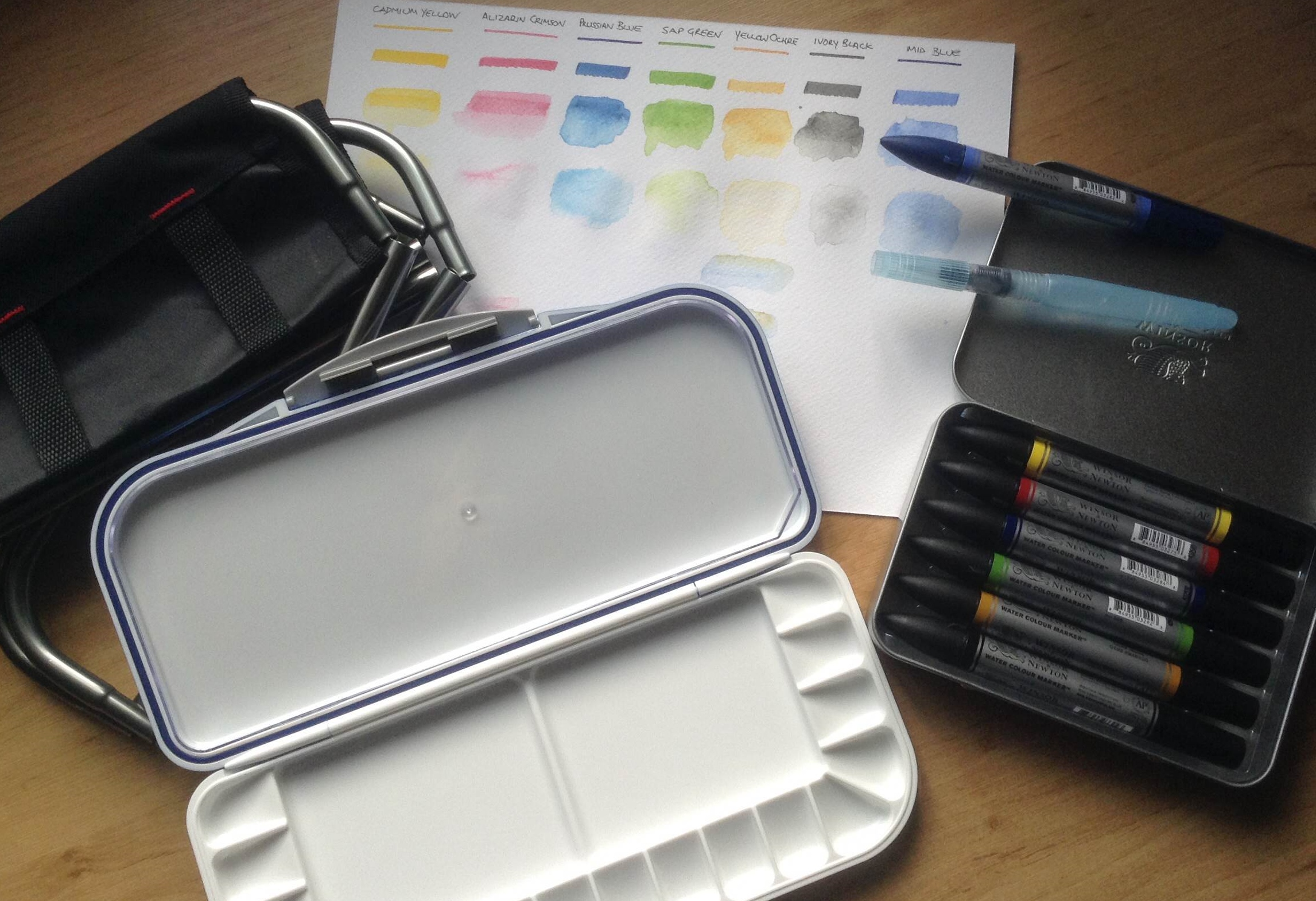
A 6x pen set of the new Windsor Newton watercolours
An airtight travelling palette
Pentel waterbrush
Tiny folding stool
All perfect for my painting holiday to Morocco.
…….thanks to my family
Having read the ‘Mostly drawing’ blog I had to see if I could make my own travelling palette using found objects.
An old memory stick case, bottle top and shortened paint brush later and hey presto. I’m used to using three colours and my favorites are: Alizarin Crimson, Phthalo Blue &Transparent Yellow, but I had to use the spare pans hanging around.
I’ll have to try it out now.
I like to draw in detail but with a fairly loose style. This means I’m attracted to some quite complicated views. When I know I have time I do enjoy the puzzle of putting together a complex drawing. However, they can be spoiled by an unsympathetic wash and you will see this more than once below.
My first ‘Grand Design’ was the British Museum. I’d just returned from a work colleagues memorial service in Mayfair and it was a beautiful winters day, bright but with a cold wind. I planned to paint inside but the view from the gardens enticed me and I had a go. The wash is not complete as the cold and my need to be comfortable took over.
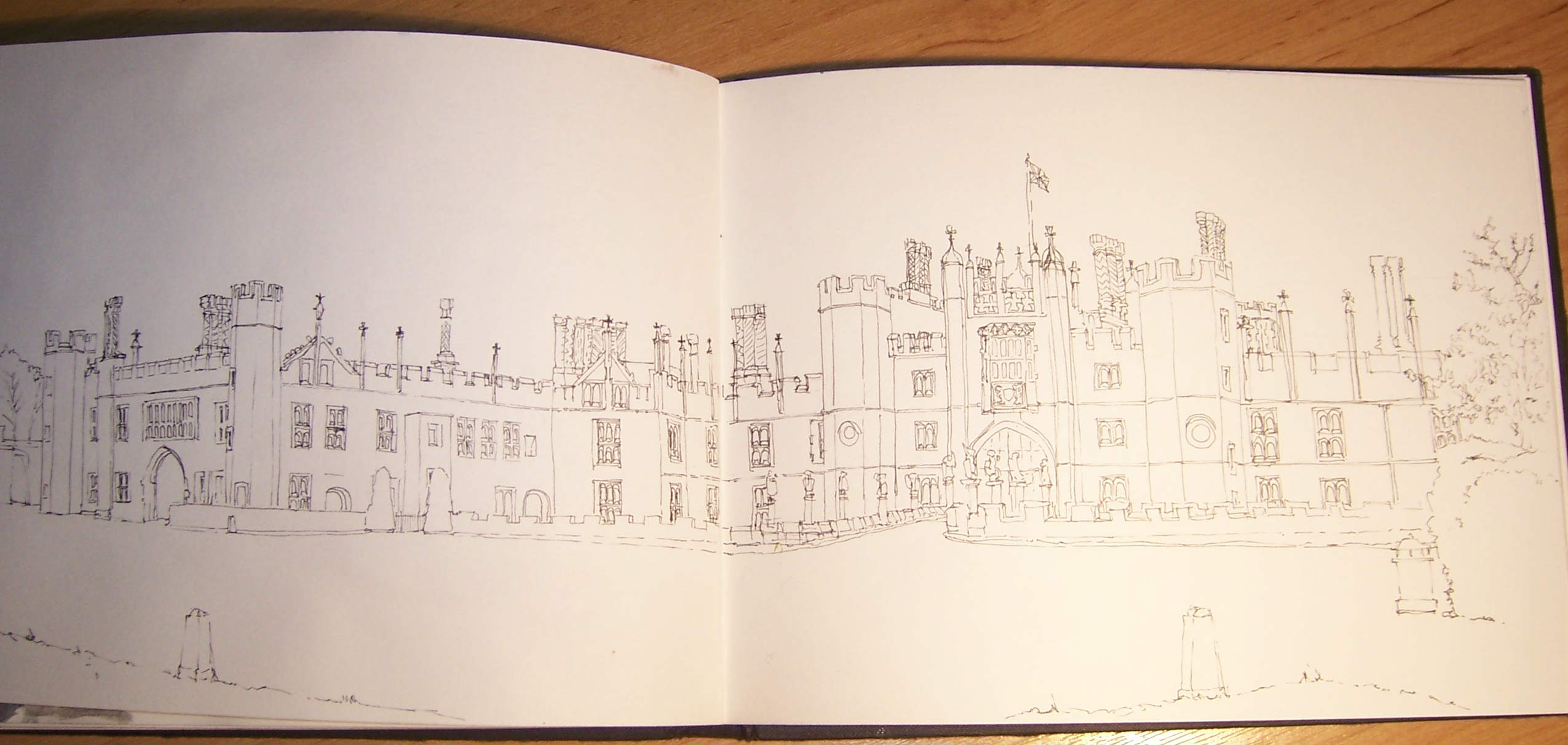
My next complicated drawing was taking on the Tudor facade of Hampton Court. I arrived early and the crowds had not arrived. I didn’t want a full on view so i sat on the river side of the building and sat down behind a tree, to get out of the raw wind.
Having completed the drawing I had to return home to paint the scene as I was cold and hungry. The sun was low and the facade was in shadow. I painted it as I saw it but this didn’t produce a sympathetic painting. I should have thought about the colours more.
A ‘Grand Design’ in my mind doesn’t have to be one building but can be in this case a line of beautiful houses. I decided to start this sketch as I only had limited time on my parking meter. I returned and started painting on a second visit. I stopped painting when I saw that the drawing was getting lost. I did return to the painting on a second session to provide more detail.
The final ‘Grand Design’ is of Ardingly College. I was attending a Tango festival, which included workshops and an evening Milonga. I turned up early and made the most of a brief spell of good weather. The building is complicated but I enjoyed the puzzle of drawing it in scale and simplifying the lines. In front of the building were large playing fields and I made the error of including them in my painting rather than the sky. I’ve cropped them out in the picture below.
I’ve be looking at the watercolours on Google search again. The search terms are usually a mixture of urban, sketching and watercolours.
The latest inspiration for me is Thomas Schaller, a fantastic artist from the US. His skills with watercolour washes are breathtaking. He has a great blog and generously shares his work with the world. Looking through the blog I found a wonderful watercolour of Sienna. I needed to try painting it, to learn from the composition, washes and tones. My attempt is clumsy but then I am learning from a multi-award winning professional, something might rub off.
Out and about locally with my sketchbook and folding chair on Saturday.
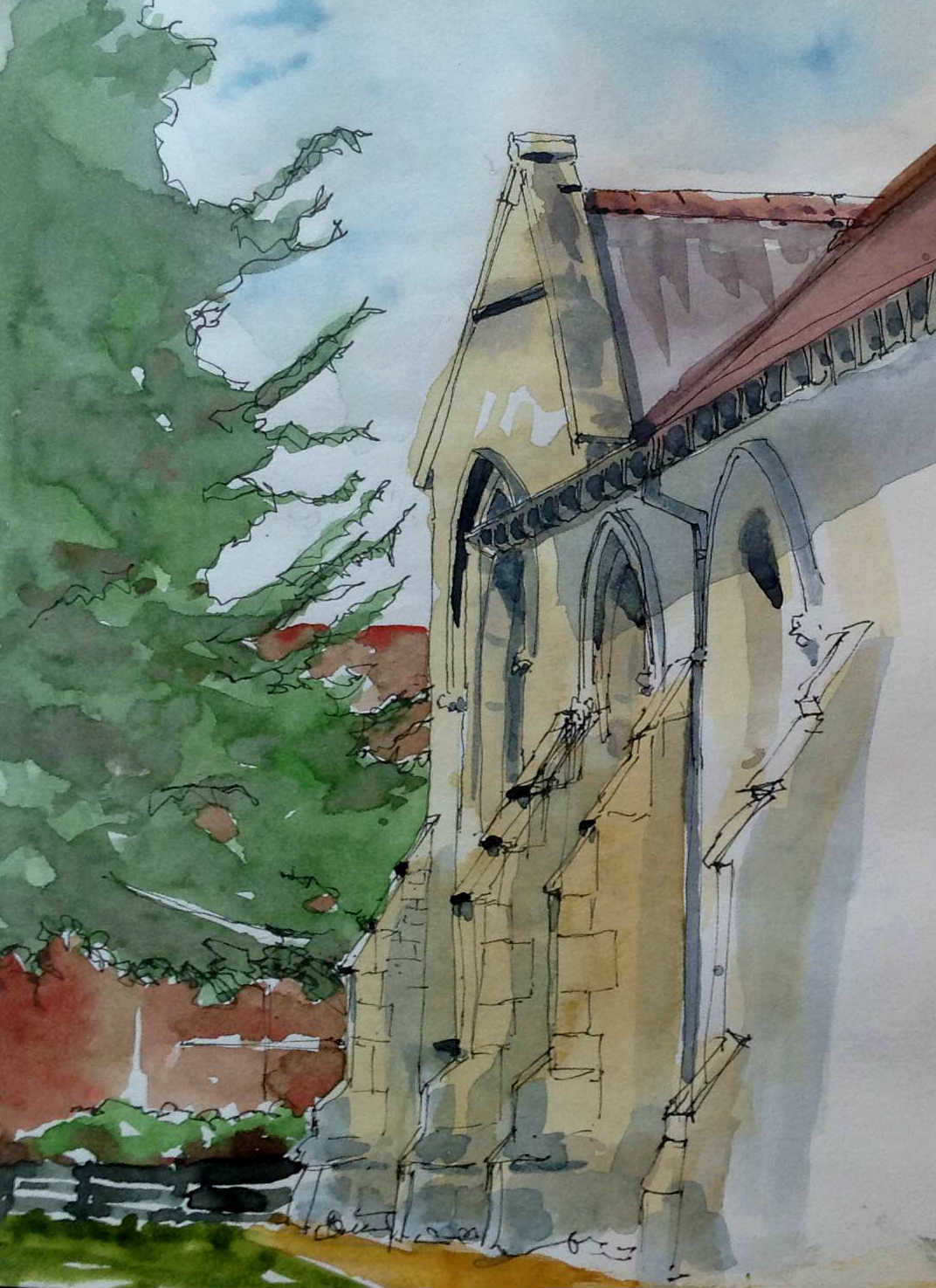
First was a quick study to get me settled in. I didn’t want to drive to a location so I walked around locally for inspiration. The early morning sun was casting great shadows but I knew by the time I got to using the paints it would have changed.
I found the garden for our local Church and settled into a warm up study. The vicar discovered me quite quickly and we had a chat. He monitored my progress throughout the time and was very encouraging. I liked the spot as it had interesting shadows and contrasts. The idea was to work cold and put something down quickly, without too much drawing. I was there about 30 minutes
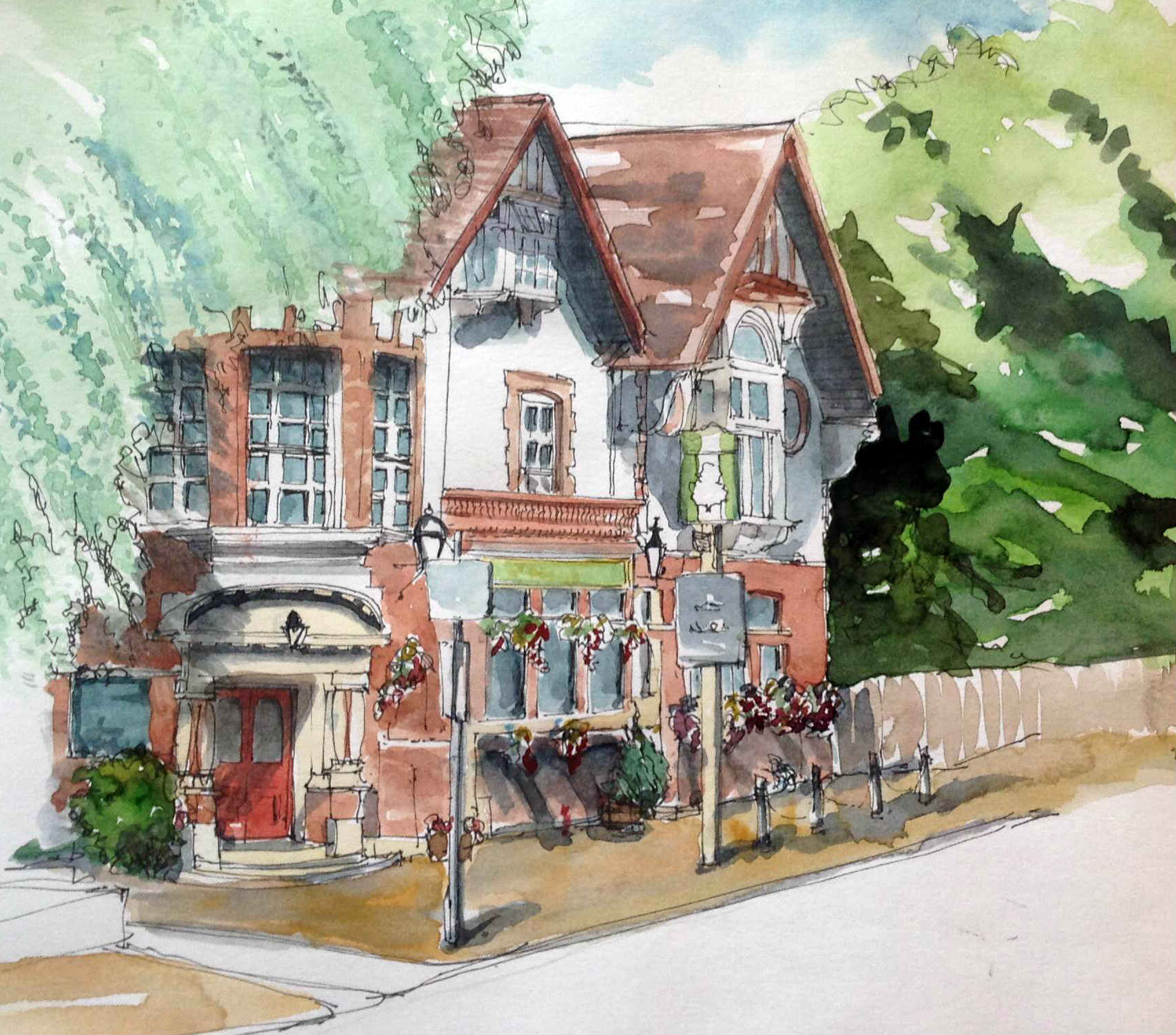
Having warmed up I went to find a more varied subject and spent more time painting. I’ve been inspired by a Canadian urban sketcher, Marc Taro Holmes. I’ve ordered his book and can’t wait to learn more from his experience. He uses line and wash but his drawing and painting skills are amazing. My attempt of a large Victorian pub is very primitive, with poor washes but I realize it will taking time and plenty of practice.
I drew in pencil, drew over the pencil in ink and placed the washes in about 90 minutes. A few interesting people to talk to, including an encouraging church helper who was dead-heading the roses outside the church hall. Painting outside is always tiring and you can’t get the concentration levels possible in the studio. So by the time you get to the washes your brain is in another place and you don’t get the results you want.
Having spent time on the Moroccan paintings I needed to see if I could apply the techniques to an original painting. Of course the subject matter was the big question. One of the thoughts going through my mind about composition is what if I’m stuck with a mundane subject in the field. So I wanted to take a fairly average, still sympathetic subject to paint and ‘discover’ a painting with in it.
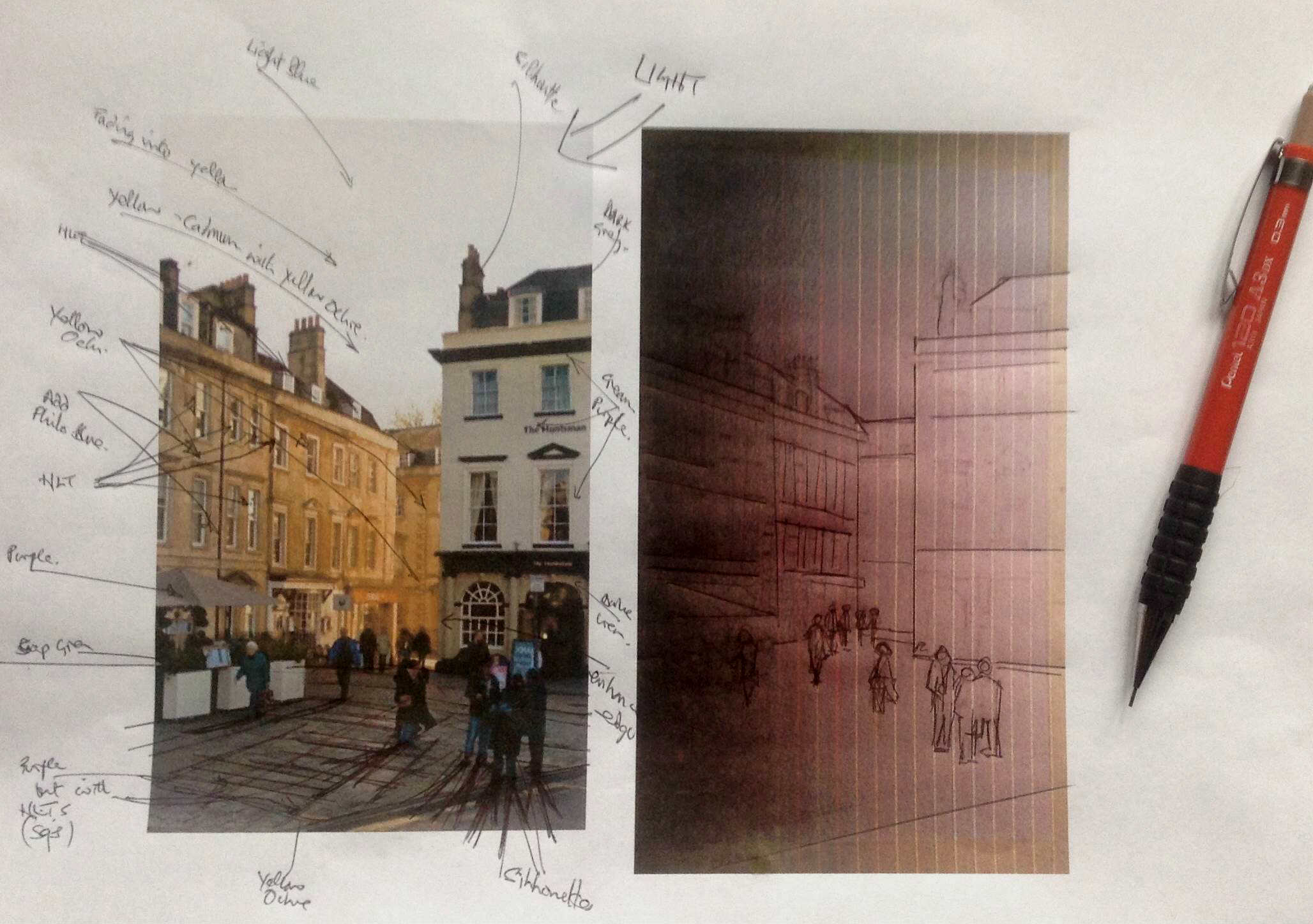
I found this picture of Bath and looked at possible compositions.
Two of the most obvious are marked on the photo. I felt the portrait version (red) was worth taking forward. It had interesting light and not so many windows. So I made a sketch of the scene to understand the composition more, identifying tone, depth and detail.
This was also very valuable in identifying angles and dimensions. There was a lot of pavement and this would be broken up by people and perspective lines but from a balance point of view this worried me. I moved to the next stage by drawing the scene on to watercolour paper. To check angles and dimensions I printed out the line drawing against the original photo.
Even after doing this I made several key errors on the drawing which I din’t find out until I was well into painting.
The final painting is below. For me its still not quite to my taste. Its a useful study and I will have learnt things but the composition is a little boring, the balance is not quite right, the perspective is out in places and the colours are not fresh enough. There is not enough interest in the darks and not enough life in the lights.
Have I progressed from the Moroccan paintings? Not really, I’ve used some thoughts about the use of the buildings and people, but not enough to make a difference. Keep pressing on….
On my painting holiday to Florence in 2013 I felt I had made good progress with my sketchbook. The line and wash paintings of Florence, Lucca and Pisa worked well in the sketchbook, plus the drawings of the statues were newly learnt techniques and felt satisfying. However, the one area that I completely failed was in producing a typical watercolour on location. The two attempts were very disappointing and I’ve been trying to work out what I need to do to rectify this for my trip to Morocco.
I’ve looked at paintings of North Africa and the Middle East on Google images and pinterest that I find represent the colours and flavour of the region. The images need to be produced on location and in a short time. I’ve painted them to see what I can learn from their construction and composition. As I don’t know who owns the original paintings I can’t show them on this blog but I feel I have captured their essence.
The first shows a market scene with locals, donkey and sun shades.
The buildings are very simple but basic perspective makes the picture work. The sky colour is almost purple but the focus is on the people and donkey. The extreme darks in the shadows provides depth and the curve in the street lends an air of mystery. The pots provide a simple but needed detail. The people are essentially silhouettes.
The second picture is from the same artists (if anyone knows who it is please tell me) and follows similar principles to the first picture. Its not as mysterious but the donkey is a strong part of the picture as well as the two silhouettes.
The third picture is a much more complicated painting and I doubt it can be produced in situ. However, I loved the tones in the buildings and the stronger sky colour. The people were also more challenging but reflect the regions’ culture
I will produce a follow up post on my attempts in Morocco when I return….
I found out about Pintar Rapido from a dance friend, who in turn had heard it on Radio 4. Its an open painting competition, held annually and based in Chelsea. Last year was the first time it was held in London and it attracted over 380 artists. This year I entered.
The idea is to pre-book a place, register in the morning and produce a painting, in whatever medium you choose, before 8pm. The next day the paintings are hung at the exhibition hall, in Chelsea Town Hall and sold.
I spent a lot of time thinking what I could paint and even went on a days scouting in Chelsea, on a very hot day. My choices boiled down to a scene in the backstreets or Chelsea Embankment. In the end I went for Chelsea Embankment as it had lovely views of the Thames and the bridges plus I could use the wall as a work surface.
I was not alone. It proved to be a very popular place to be. I’m not sure how many artists entered this year but it looked just as busy, with a lot of them painting scenes of bridges, water, boats and skies. I started with a good sketch of Albert Bridge and boats moored up. I then found out I had forgotten my masking fluid! So I had to paint very carefully.
After about 4 hours and chats with friendly artists I felt I needed a break and went back to the Town Hall. At the registration your paper or painting surface receives a stamp so that they know your are starting with a blank surface. I had two sheets stamped so I went of to a local park and bashed out a back up.
The second painting was not a success and I felt mentally exhausted so returned to the Town Hall to mount the painting of the Thames. A photo was taken of the proud artist and the painting went to the hall for display the next morning.
The next day we all went up to view the paintings and see who won. The variety of work was extraordinary and range of materials used wide. I really liked the winning painting but my family were not impressed.
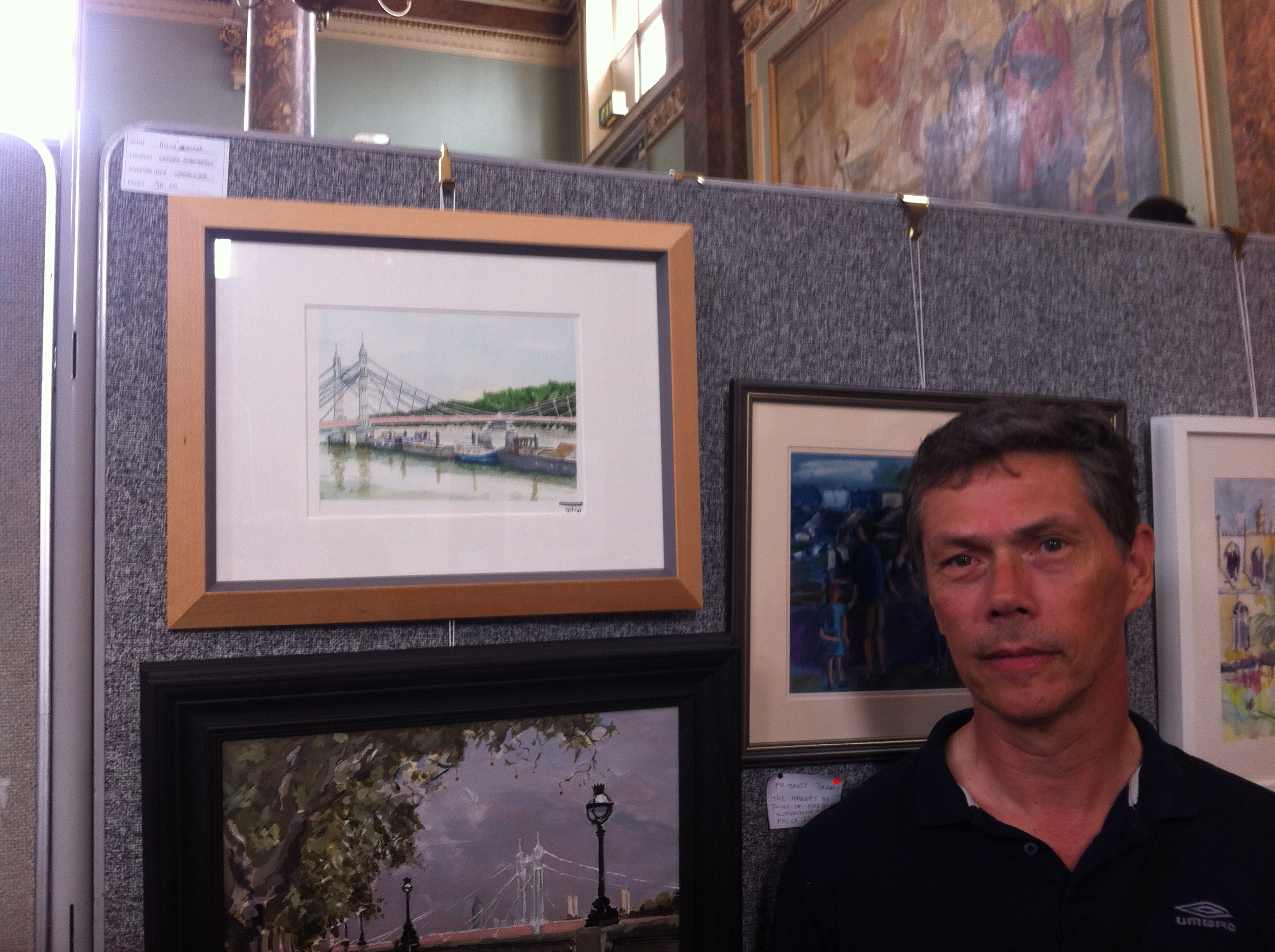
We found my piece and wondered if it would be sold. Overall there weren’t many red dots but in my section there was a little rash of them. All much better than mine and more expensive. I had priced my work low as it was not the best I could do but it did cover the cost of the frame.
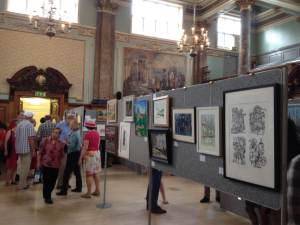
After walking round a very humid room for just under an hour we were just leaving when we noticed red dot on my work! I had sold my first painting. How exciting.
The painting with a red dot.
Additional information about the Pintar Rapido London 2014 event:
501 passes were sold, 400 artists turned up on the day, of which 380 paintings were hung and 90 sold.
Upstream from Hampton Court is Kingston-up-Thames, the closest point to the Thames from where I live. I found a place to paint there in April 2014, close to the bridge. The bridge was under scaffolding and this was not a paintable option so I chose a quiet spot in Canbury Gardens. The gardens follow the towpath downstream from Kingston Bridge and contain range of facilities such as a bandstand, cafe, toilets and rowing club. Parking is a little limited but a good place to paint.
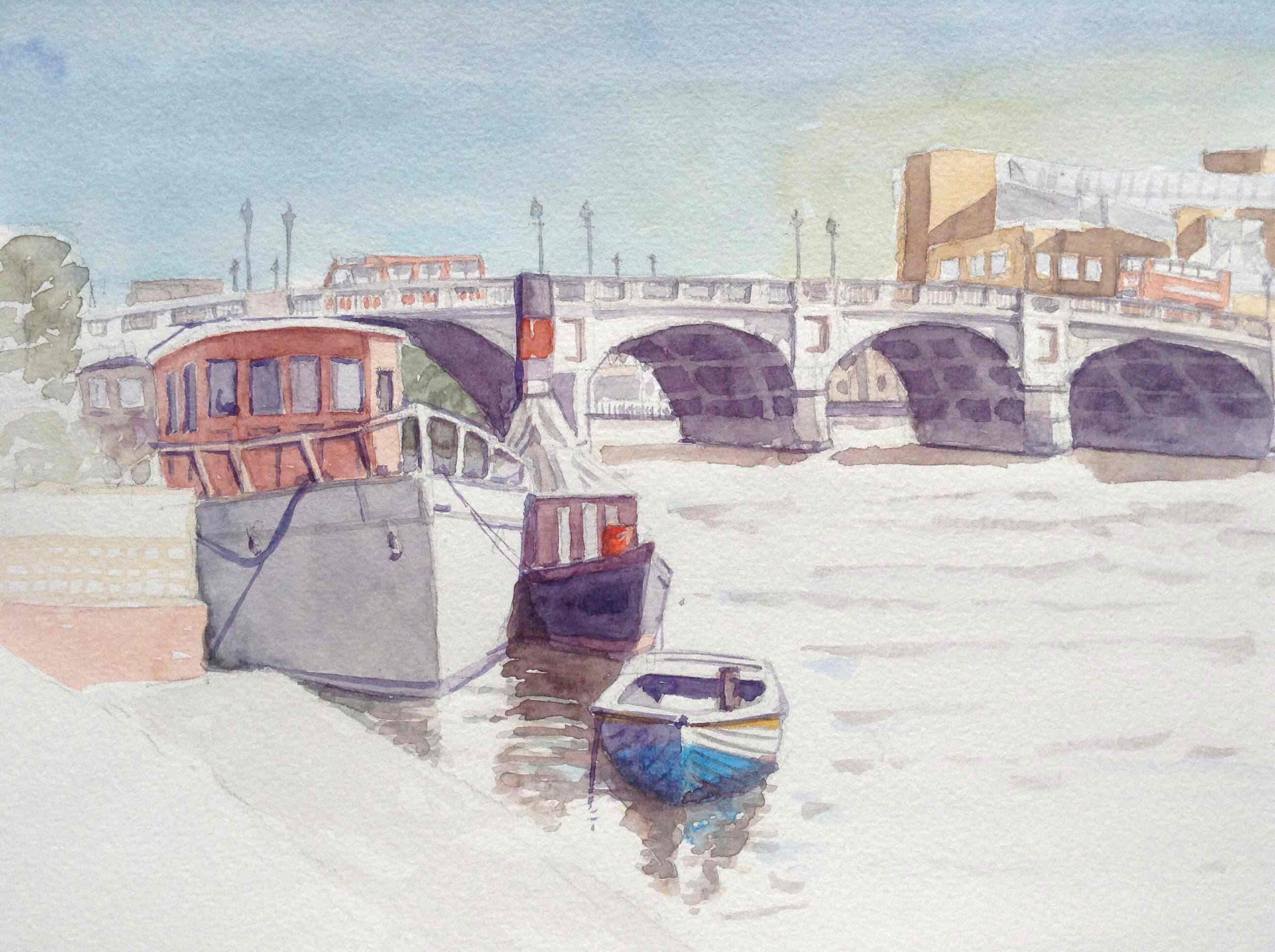
Along the towpath are small gaps used by anglers and they are good places to sit and sketch. I found such a spot and set down to paint the scene. Downstream a dingy race was underway and I included this in my painting despite the constant tacking of the boats.
Composition is a constant thought in painting. Any sketch does have simple composition decisions but with a more complex painting there are factors to be worked through. There are ‘rules’ but they can’t be taken too seriously and personal taste and what you have in front of you is equally as important. Artistic licence can improve paintings dramatically but when you are working with full intent it’s so easy to just paint what you see. (or what you think you see)
I took a little time to find this spot, liking the bend in the river, the head on profile of the central boat, the tall tree to the left and submerged rowing boat at my feet. I’m pleased with the way it came out.
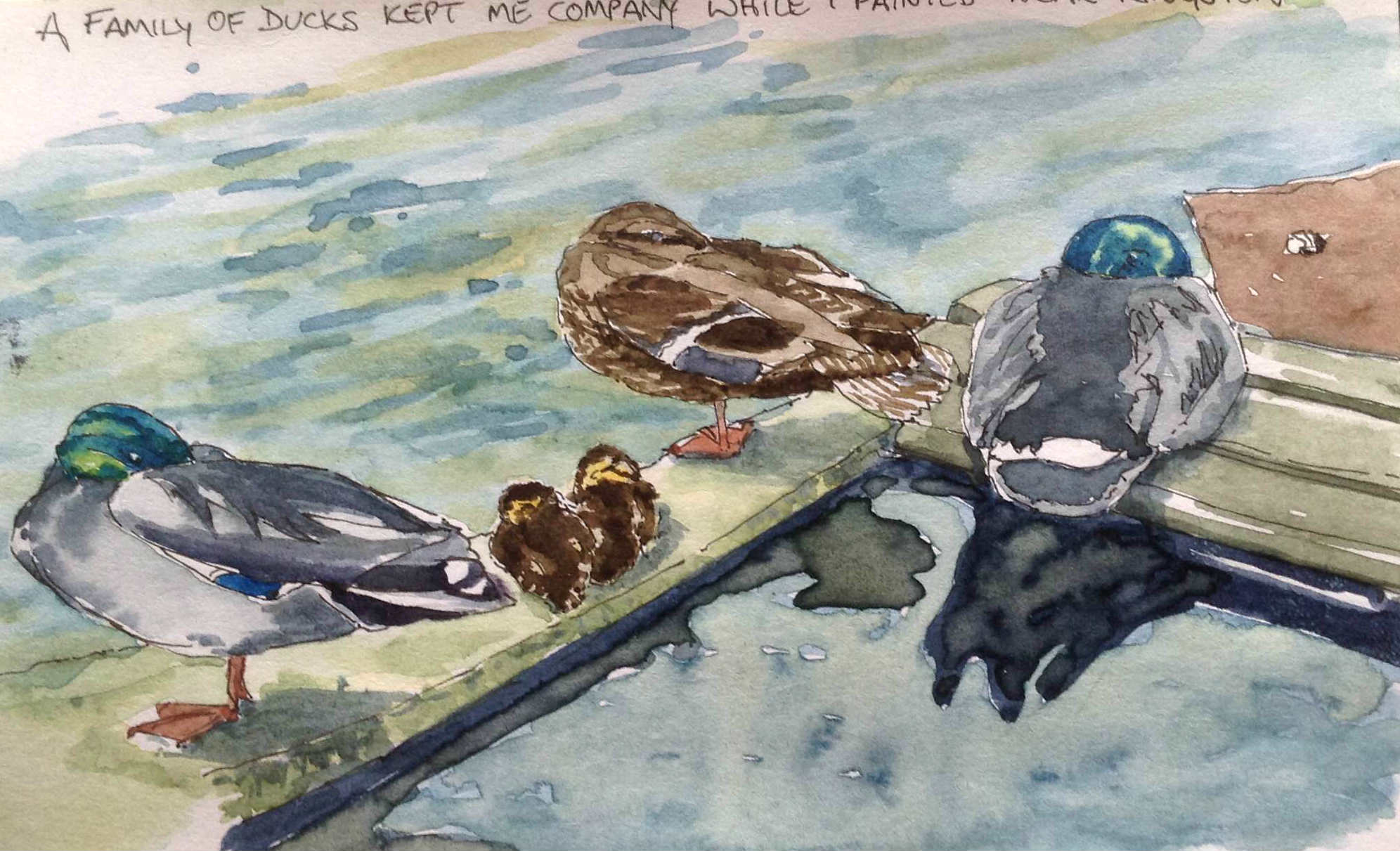
While I was sitting, painting the scene, a family of ducks came and settled on the submerged boat in front of me. They moved around this part of the bankside but were in constant threat by the Canada Geese. I took a photo when they had settled down and produced a quick sketch of them at home.
On a another trip to Canbury Park I was in a restless mood and could not decide on a composition. So I selected this boat as a study. The dark foliage against the whites of the boat interested me. How dark could I go? How much of the foliage do I paint? Not sure but this little study took a lot of time to get right and painting with watercolours its a gentle process.
This final scene was produced at least a year earlier. Its upstream of the bridge looking across to John Lewis on the far bank. I was pleased with the boat shapes but my painting let me down and I lost heart with it. The railings of the white boat are too heavy and this is not retrievable with watercolours.
Living near the Thames and growing up both alongside and on it means I’ve a strong connection with it from Weybridge downsstream to Richmond. The sketches for this post were made in early 2014, in the mornings when there was good weather and before I became too cold.
The first picture is from the Star & Garter Hill, over the looking the bend in the river. The view is spectacular, with the Surrey Hills, Heathrow and Twickenham Stadium in sight. As I painted this scene a group of canoeists came into view and I managed to capture them with a few marks.
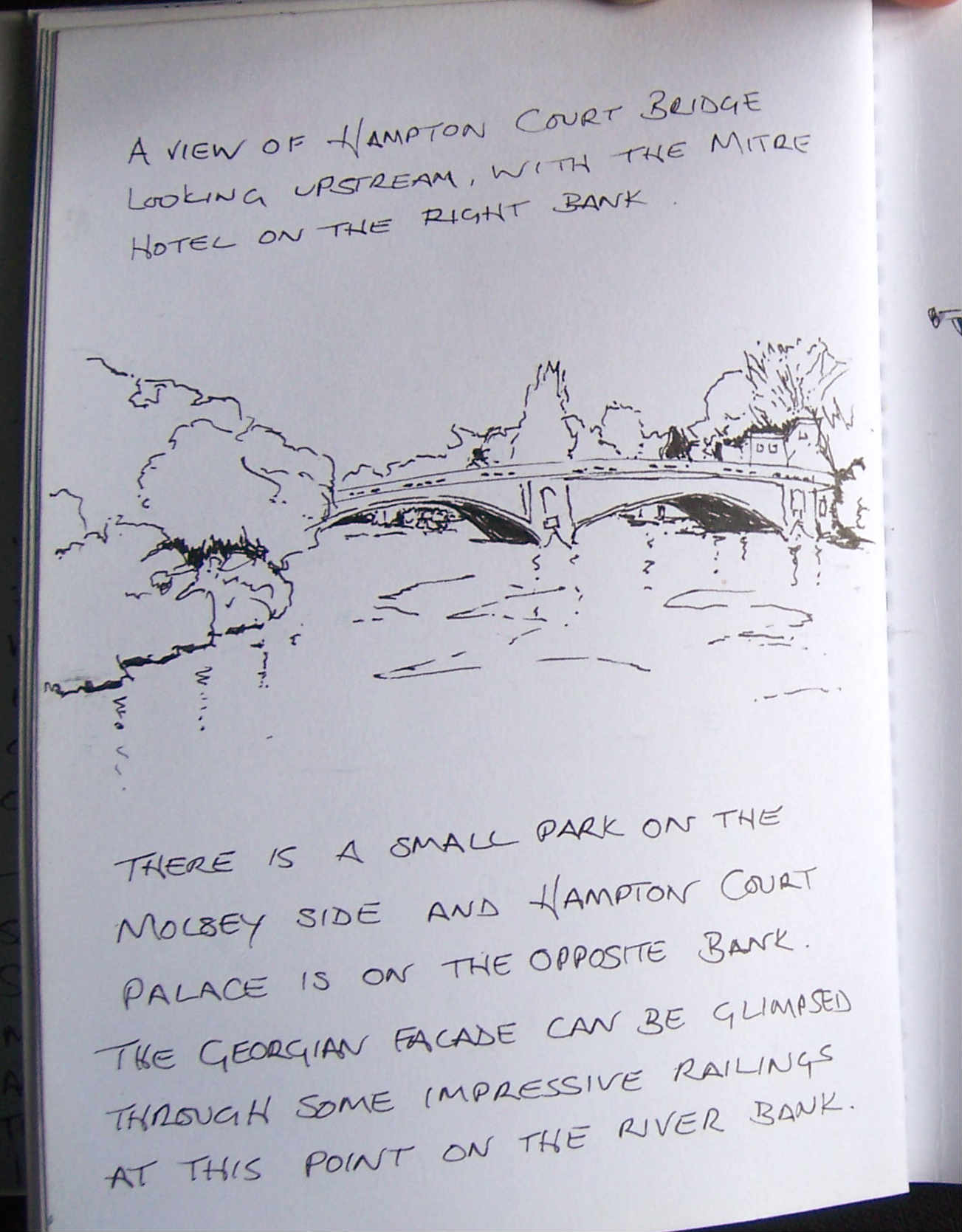
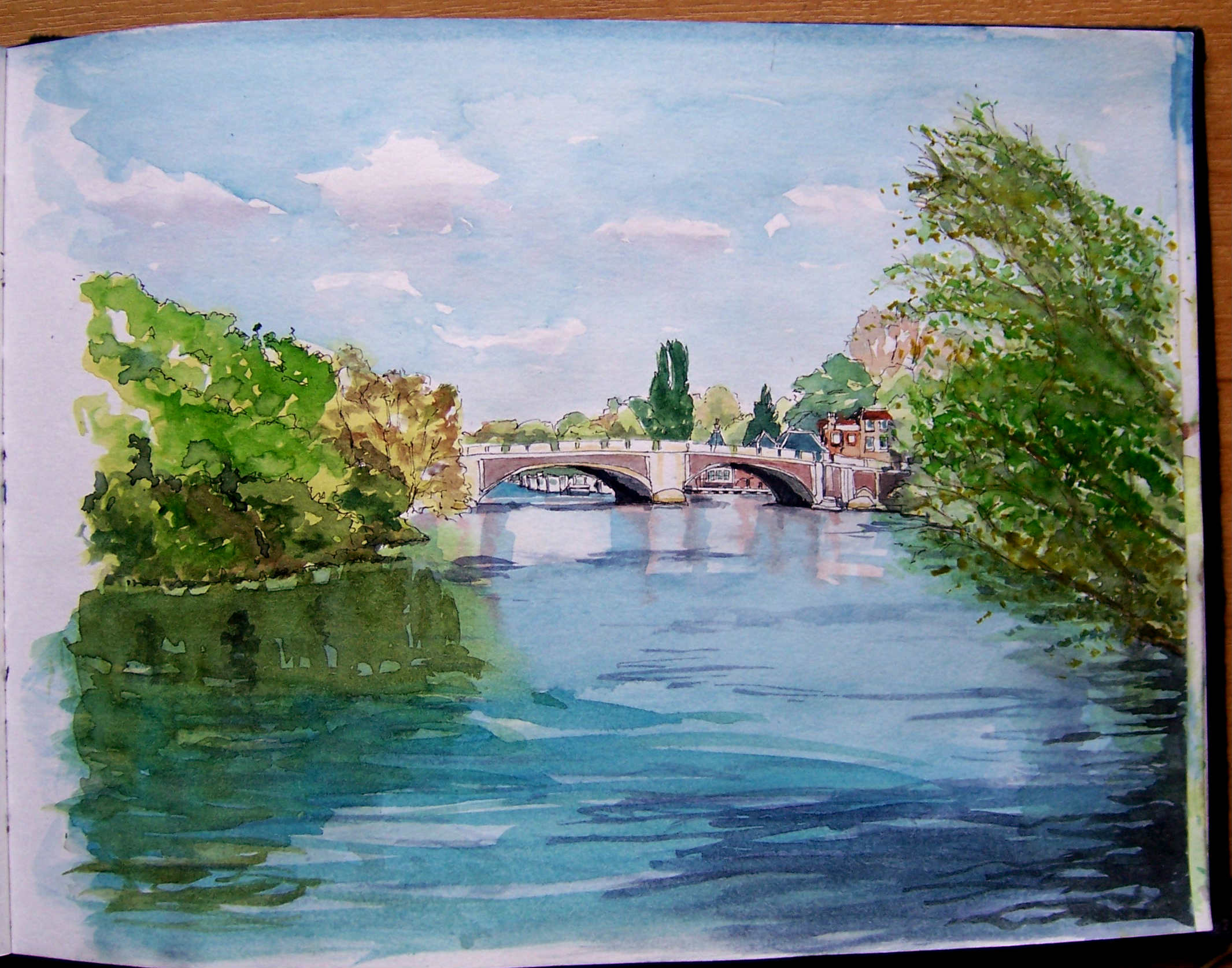
I followed up this theme with trips to Hampton Court Bridge and Kingston. I started at Hampton Court but this will be on another post called ‘Grand Designs’. As the theme is the Thames for this post my next picture is of the rather lovely Hampton Court Bridge. Seen from downstream I made this quick sketch with a picture in mind. I painted the scene again but as a line and wash in my sketchbook at home. I think there is a full watercolour picture here in the future. Tell me what you think.
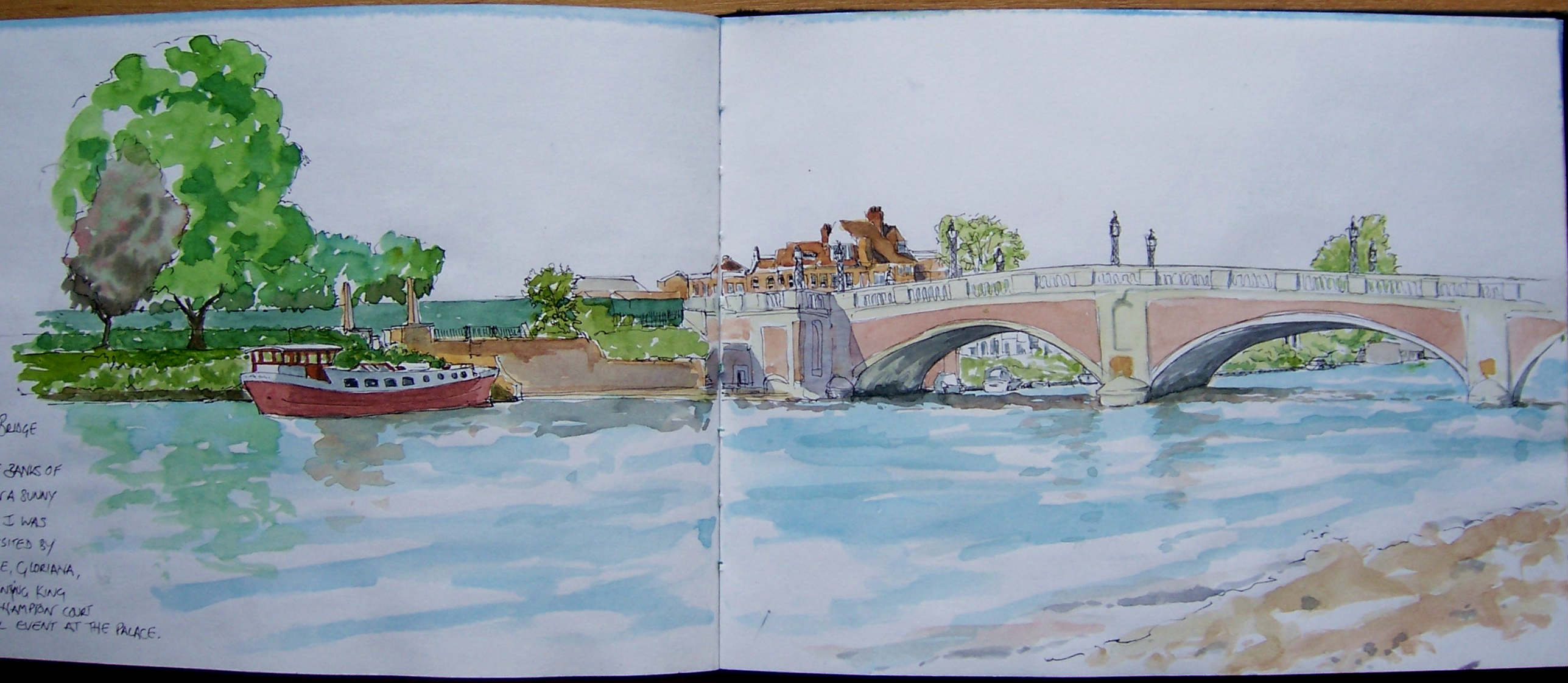
For my next picture I really wanted to paint inside Hampton Court but didn’t want to pay for the entrance fee. So I found a small beach overlooking the bridge and I’m really pleased I spent the time here. It’s one of my favourite pictures. Not too busy but with plenty of interest.
Whilst I was sitting on the beach there was a lot of activity around me. I didn’t think my presence was causing this much attention and then around the bend of the river came the Royal Barge, Gloriana. I took a quick a couple of photos and when I got home made a quick sketch in my small sketchbook. Standing up on the bridge are three figures. George I, his body guard and the barge captain.